Wastewater Treatment Introduction
Traditional chemical disinfection faces pressure from strict environmental standards and high demand for sustainable water management. Facilities worldwide seek efficient methods to process complex organics, and ozone oxidation serves as an alternative.
The global ozone generation market reached USD 1.58 billion in 2024 and will likely hit USD 2.8 billion by 2034. Currently, municipal utilities, aquaculture operations, and food processing facilities deploy ozone systems to address distinct operational challenges. While the basic science remains the same, the economic scales and implementation strategies vary significantly.
General performance metrics often obscure these critical operational differences. Organizations accurately evaluate adoption risks and potential benefits when they understand how ozone functions within these distinct environments. This trend analysis examines how ozone technology integrates into modern wastewater treatment infrastructure, why general return-on-investment claims mislead decision-makers, and what future technological advances mean for long-term operational planning.
Global Market Dynamics
The wastewater treatment segment stands as the dominant force behind global ozone technology adoption. According to SNS Insider, this segment alone generated 46.2% of market revenue in 2023. This concentration of demand reflects a methodical shift across industries that now treat ozone oxidation as a core infrastructure component rather than a supplementary unit.
Corona discharge technology leads the hardware adoption. Fortune Business Insights reports that corona discharge ozone generators represent 45% of deployments globally because this generation method scales predictably across facility sizes and maintains stable output under variable operating conditions. Facilities need continuous and high-volume ozone production. They gravitate toward corona discharge systems because empirical performance data supports their reliability across demanding industrial environments.
These market dynamics matter because they shape how capital flows into each sector. Municipal utilities, aquaculture operations, and food processing plants all contribute to this growth, yet their investment logic and operational priorities diverge sharply. Organizations that explore sustainable farming practices and adjacent water management strategies gain benefits when they understand these distinctions before they commit resources. Operators see the sector-level differences more clearly when they examine each application environment individually, and this examination begins with the strict regulatory demands of municipal utilities.
Municipal Infrastructure
Municipal utilities face some of the most demanding regulatory environments for effluent management globally. Discharge standards continue to tighten around micropollutant removal, pathogen inactivation, and water reuse readiness.
GM Insights valued the municipal ozone generator market at USD 143.5 million in 2024 and projected a 7.2% compound annual growth rate through 2034. This growth trajectory reflects systematic capital commitments rather than speculative spending.
Municipal ozone systems address several operational needs that conventional chemical dosing struggles to meet.
-
They eliminate pathogens and do not generate harmful disinfection byproducts.
-
They degrade pharmaceuticals and endocrine-disrupting compounds in secondary effluent.
-
They enhance color and odor control and improve downstream water reuse viability.
-
They reduce long-term chemical procurement and storage costs.
These advantages position ozone as a critical enabler for utilities that prepare their infrastructure to meet next-generation discharge permits and potable reuse standards. The economic case strengthens further when facility operators examine how recent material science developments accelerate treatment efficiency.
Effluent Purification Technology
New catalytic materials change what municipal water systems can achieve per unit of ozone applied. Scientists at the University of Science and Technology of China developed a nitrogen-doped biochar from agricultural waste cotton hulls, and this material enhanced treatment efficiency 100-fold compared to ozone alone. The biochar catalyzes the breakdown of complex organic pollutants and generates more reactive oxygen species from the same ozone input.
This development carries precise implications for municipal plant economics. If a facility can degrade the same volume of pollutants with a fraction of the ozone dose previously required, energy and generation costs drop proportionally. The catalytic material also retained approximately 80% of its activity across multiple reuse cycles, and this retention suggests that ongoing material replacement costs remain manageable. These efficiency gains improve baseline treatment economics and remove chemical residues, and this prepares facilities to implement advanced water reuse programs.
Circular Resource Models
The logical extension of advanced ozone treatment in municipal systems involves water recycling at scale. Ozone-treated effluent contains no persistent chemical residues, and this lack of residues makes it a cleaner feedstock for industrial recycling, agricultural irrigation, and indirect potable reuse programs. Facilities that invest in ozone infrastructure today position themselves to participate in circular resource models as regulations evolve.
Chemical-free disinfection removes a significant barrier to reuse acceptance. Industrial partners and agricultural operations that receive treated water demand assurance that residual treatment chemicals will not compromise their processes or products. Facility optimization strategies that incorporate ozone from the outset reduce the retrofit costs that utilities would otherwise face when recycling mandates arrive. This municipal-scale planning horizon contrasts sharply with the shorter and production-driven investment cycles found in aquaculture.
Ozone Dynamics In Aquaculture
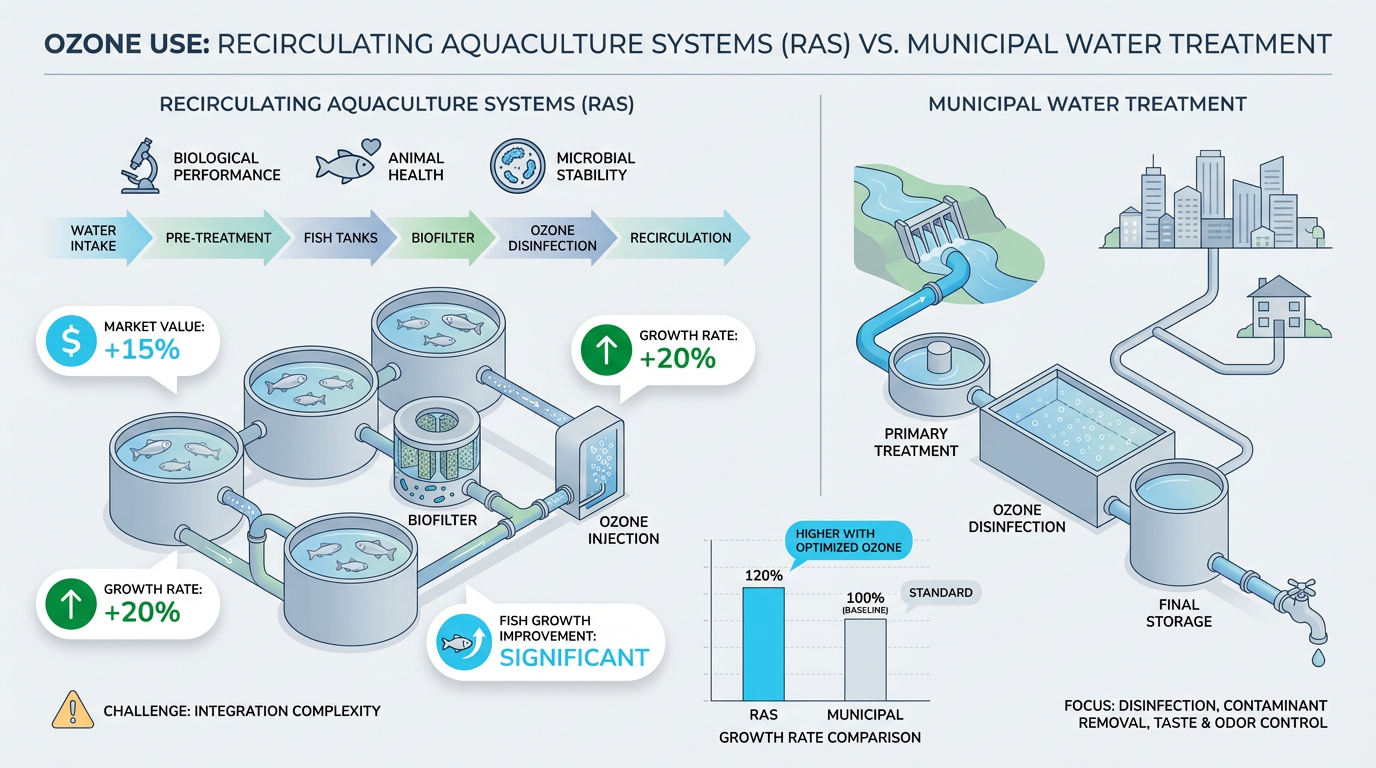
Ozone operates under a fundamentally different set of objectives in aquaculture than in municipal infrastructure. In closed-loop recirculating aquaculture systems, the primary goal is not regulatory compliance. The primary goal is biological performance. The system market itself reflects this growth pressure.
GM Insights valued the global recirculating aquaculture system market at USD 3.4 billion in 2024 and projected a 9.4% compound annual growth rate through 2034. Ozone plays a structured role in these systems because it simultaneously disinfects water, oxidizes dissolved organics, reduces turbidity, and improves dissolved oxygen availability.
The objective performance gains demonstrate clear benefits. Research published in Science Gate demonstrated that a combined oxygen and ozone fine bubble system increased fish growth rates by 52.8% compared to conventional aeration alone. This kind of biological output improvement translates directly into faster time-to-market size, better feed conversion ratios, and reduced pharmaceutical intervention. In aquaculture, the economic justification for ozone centers on production throughput and animal health rather than on discharge permits or chemical cost displacement.
The water treatment challenges in aquaculture also differ at a material level. Saltwater operations contend with accelerated corrosion of ozone contact equipment. Dosing protocols must account for the sensitivity of biofilters that maintain nitrogen cycling in closed loops. Effluent purification in these environments requires careful calibration to prevent disruption to the microbial communities that keep the entire system stable.
Recirculating aquaculture system design must integrate ozone as one component within a tightly interdependent biological network and must not treat it as a standalone stage. These implementation realities make it clear that aquaculture operators cannot simply adopt municipal ozone specifications and expect comparable results.
Food Facility Integration
Food and beverage manufacturers adopt ozone to preserve product quality and safety without leaving chemical traces on the final product. This reason differs from municipal utilities and aquaculture operations. Data Intelo valued the global ozone food disinfection market at USD 1.12 billion in 2024 with a 7.8% compound annual growth through 2033. This growth stems from precise performance gains across the production chain.
Food facilities integrate ozone at multiple stages:
-
First, these facilities treat wash and rinse water for fresh produce. The ozonated water eliminates surface pathogens and extends shelf stability without affecting taste or texture.
-
Second, workers treat carcass and poultry surfaces with gaseous ozone to reduce microbial loads before packaging. Research published in PMC found that gaseous ozone treatment at 10 mg/L extended shelf life of chicken legs by four to five days compared to untreated controls.
-
Third, operators use ozone for clean-in-place sanitation of equipment, tanks, and conveyor systems. The ozone replaces chlorine-based sanitizers and reduces rinse water volumes.
-
Finally, plant managers implement water reuse loops. The ozone-treated process water returns to earlier production stages and lowers total freshwater intake.
Sector-Specific Economic Analysis
Blanket return-on-investment projections for ozone technology fail under scrutiny because each sector justifies capital spending through entirely different savings mechanisms. A logical comparison across municipal, aquaculture, and food facilities reveals these differences.
Municipal utilities recover ozone investments primarily through chemical displacement and regulatory cost avoidance. Pinnacle Ozone Solutions reports that ozone systems achieve a payback period of 2.5 to 4 years in wastewater treatment facilities on average. Over longer time horizons, ozone displaces 40–75% of chemical costs across 10 to 15 years of operation. Effluent purification at this scale involves significant upfront capital, but the savings compound predictably because chemical procurement, storage, and handling costs continually increase.
Aquaculture operators measure returns differently. Their payback calculations center on faster fish growth, improved feed conversion, and reduced pharmaceutical spending. Capital outlays tend to be smaller than municipal systems, and the revenue impact of a 52.8% increase in growth rates shortens payback timelines considerably.
Food facilities build their empirical case around shelf-life extension revenue, recall cost elimination, and reduced sanitation chemical purchases. A four-to-five-day shelf-life gain on a poultry product line translates into measurable reductions in waste and distribution losses. Each sector's financial model operates on fundamentally different variables.
Future Technology Innovations
New technologies address the operational variability that currently separates ozone implementation across sectors. EIN Presswire projects the ozone technology market will reach USD 2.7 billion by 2033. The systematic integration of artificial intelligence and sensor-based platforms into ozone dosing and monitoring workflows drives this growth.
Artificial intelligence dosing algorithms adjust ozone output in real time based on influent water quality, organic loading, and temperature fluctuations. This objective approach reduces overdosing waste and underdosing risk across municipal, aquaculture, and food facility environments. Automated monitoring systems connect to Internet of Things sensor networks. These connected networks enable predictive maintenance scheduling and continuous performance verification without manual sampling.
These innovations share a common benefit. They lower the operational expertise barrier that currently makes ozone adoption uneven across facility types. Catalytic enhancements improve ozone utilization efficiency, and intelligent controls standardize dosing precision. These improvements make water reuse pathways more accessible to facilities that previously lacked the technical staff to manage complex oxidation systems.
Conclusion
To summarize, organizations will continue to expand their use of ozone-based wastewater treatment across municipal, aquaculture, and food processing environments as water scarcity and process efficiency demands intensify globally. These organizations base their adoption strategies on sector-specific economic models rather than general market projections.
Facilities become more efficient when they align their capital investments with actual operational objectives. They will soon see new catalytic enhancements and automated platforms widen the performance gap between optimized systems and standard chemical alternatives.
Agritopia provides specialized consulting services on ozone integration for facilities that navigate these operational changes. Reach out for consultation to discuss how specialized technology solutions can align with your specific infrastructure requirements.