Introduction
Agriculture alone accounts for roughly 70 percent of global freshwater withdrawals, according to the FAO's AQUASTAT database. The 2024 UN World Water Development Report confirms that approximately four billion people experience severe water scarcity at least one month each year.
Effective water management is no longer reserved for utilities. It is an operational imperative for organizations of every size. Yet available guidance on monitoring, treatment, recycling, and disinfection arrives scattered across disconnected sources that rarely address small-scale realities, and facility managers cannot synthesize these recommendations into a workable system.
A coherent framework connects these pillars so that data drives treatment decisions, output quality enables safe recycling, and sustainable disinfection closes the cycle. The sections below explore how small organizations can implement this integrated approach within realistic constraints. For additional insights on treatment technologies and agricultural water quality, we publish regular research on our blog.
Why Fragmented Approaches to Water Management Fall Short
Most small facilities do not struggle with water management because they lack options. They struggle because available guidance arrives in disconnected pieces that do not communicate with each other. A regulatory agency publishes monitoring protocols. A vendor supplies treatment specifications. A separate document covers reuse permits. The facility manager is left to act as the unpaid systems integrator who tries to stitch them together.
This fragmentation carries real operational costs. A facility might install a filtration unit without first an understanding of what contaminants its source actually contains, or it might collect rainwater without a reliable disinfection step before that water reaches irrigation lines. Each standalone project appears sound on paper but underperforms in practice because it was designed against assumptions rather than measured conditions.
A peer-reviewed study on integrated rainwater harvesting and greywater reuse, published in Water (MDPI, 2016), demonstrated that unified systems at the Tecnológico de Monterrey campus in Mexico achieved up to 42.5 percent potable water savings when sources were combined and managed as a single train. Standalone rainwater or greywater systems delivered significantly lower returns.
When monitoring data feeds directly into treatment decisions, and treatment output quality determines which reuse applications are safe, the entire operation becomes a closed loop where each component reinforces the next.
Monitoring: The Data Foundation of Water Management
Treatment equipment and reuse infrastructure represent significant capital investments, and both depend on accurate knowledge of what the water actually contains. Generic vendor recommendations often assume standard municipal supply conditions, but small facilities frequently draw from wells, surface sources, or municipal lines with substantial local variability. Operational data replaces guesswork with precise inputs that shape every downstream decision.
Both the Water Environment Federation's decentralized reuse guidance and the World Health Organization's water safety frameworks emphasize that real-time or high-frequency monitoring data is essential to optimize treatment protocols and prevent cross-contamination in reuse systems. Without continuous or frequent data collection, operators cannot detect quality shifts that occur between seasons, after heavy rainfall, or when upstream conditions change.
Monitoring is not a preliminary step that ends once treatment hardware arrives. It operates as the continuous feedback mechanism that tells operators whether their treatment and water reuse systems actually perform as designed.
How to Select Parameters for Sustainable Water Management
Not every parameter listed in a municipal testing manual applies at a small-facility scale. Sustainable water management relies on metrics that directly affect treatment and reuse decisions rather than dozens of readings that produce data without actionable insight.
For facilities that direct treated water toward landscape irrigation, pH, total dissolved solids (TDS), electrical conductivity (EC), and coliform bacteria counts represent the core measurement set. These four parameters determine soil compatibility, vegetation health risks, and biological safety. Operations that reuse water for equipment wash or coolant cycles may add turbidity and chemical oxygen demand (COD). The exact combination depends on the end use, not on a universal checklist.
How to Choose Between Basic Kits and Real-Time Sensors
Manual test kits and automated sensors serve different operational profiles. Basic colorimetric and strip-based kits typically cost between $50 and $200 for small-facility applications. Real-time sensor systems with data logs range from approximately $2,000 to $8,000, dependent on the number of parameters monitored and the connectivity features required.
Manual kits work well for operations with steady source quality and low reuse volumes. The tradeoff involves labor time and the blind spot between sample events, during which quality shifts go undetected. Real-time sensors eliminate that gap because they log measurements continuously and alert operators when thresholds are exceeded. For facilities that reuse greywater or draw from variable sources like surface ponds, the continuous visibility that sensors provide often justifies the higher upfront cost.
Monitoring Frequency for Water Reuse Systems
Test frequency should match the risk profile of each reuse application rather than follow a single calendar schedule. Water reuse systems that employ subsurface drip irrigation, where human contact is minimal, may require weekly coliform and pH checks. Process water applications with higher contamination consequences, such as food-contact surface wash, call for daily or continuous microbial monitoring.
Consistent frequency matters more than occasional intensive tests. A facility that tests three parameters weekly generates a far more useful dataset than one that runs a full panel once per quarter. Trends in pH drift, elevated TDS, or seasonal coliform spikes become visible only through regular measurement.
Treatment Technologies Matched to Small-Scale Constraints
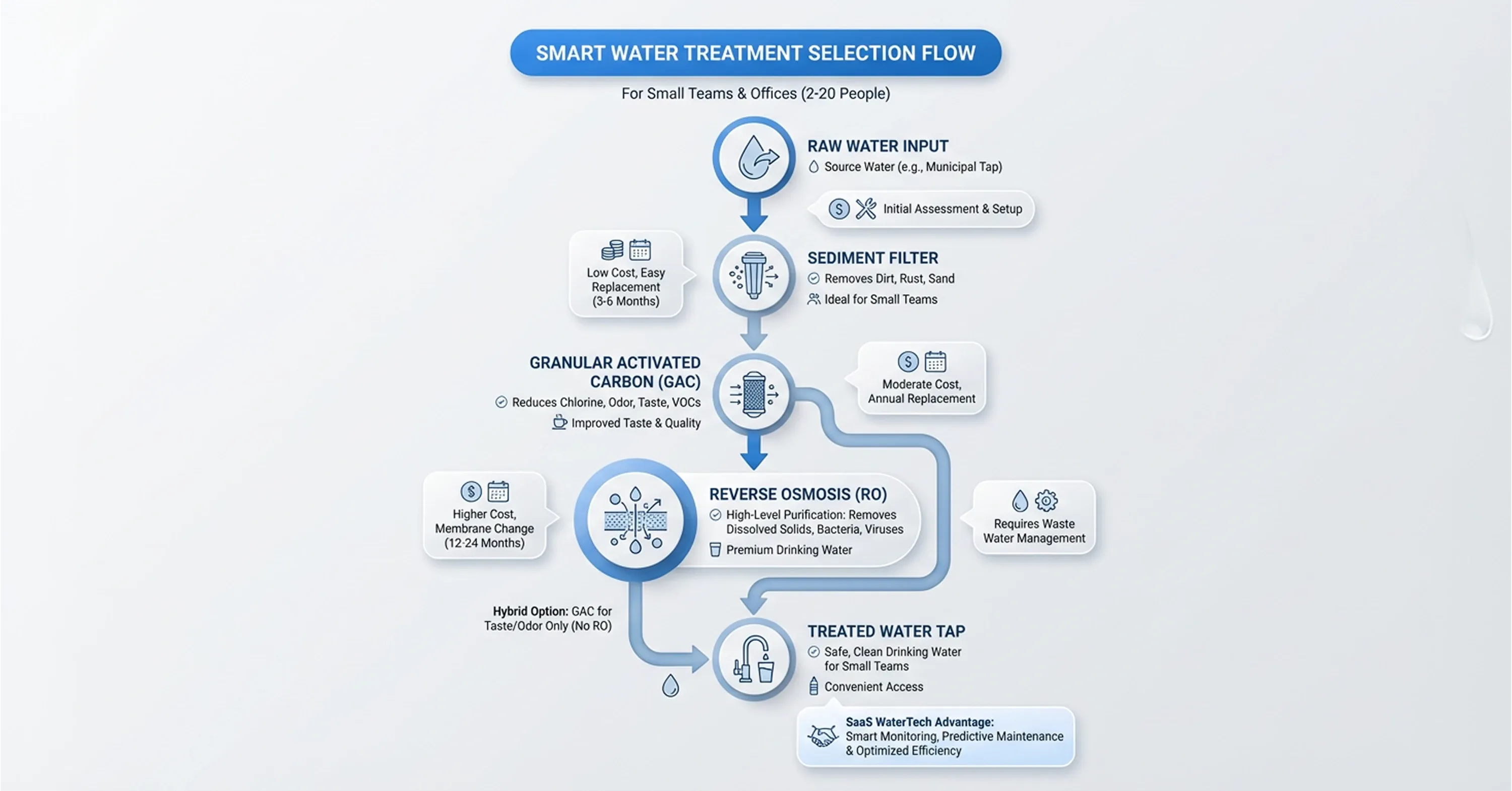
A technology that performs well at utility scale may demand maintenance routines, chemical handling, or calibration expertise that a three-person operation simply cannot sustain. Effective water management at this scale requires technology that matches operational capacity.
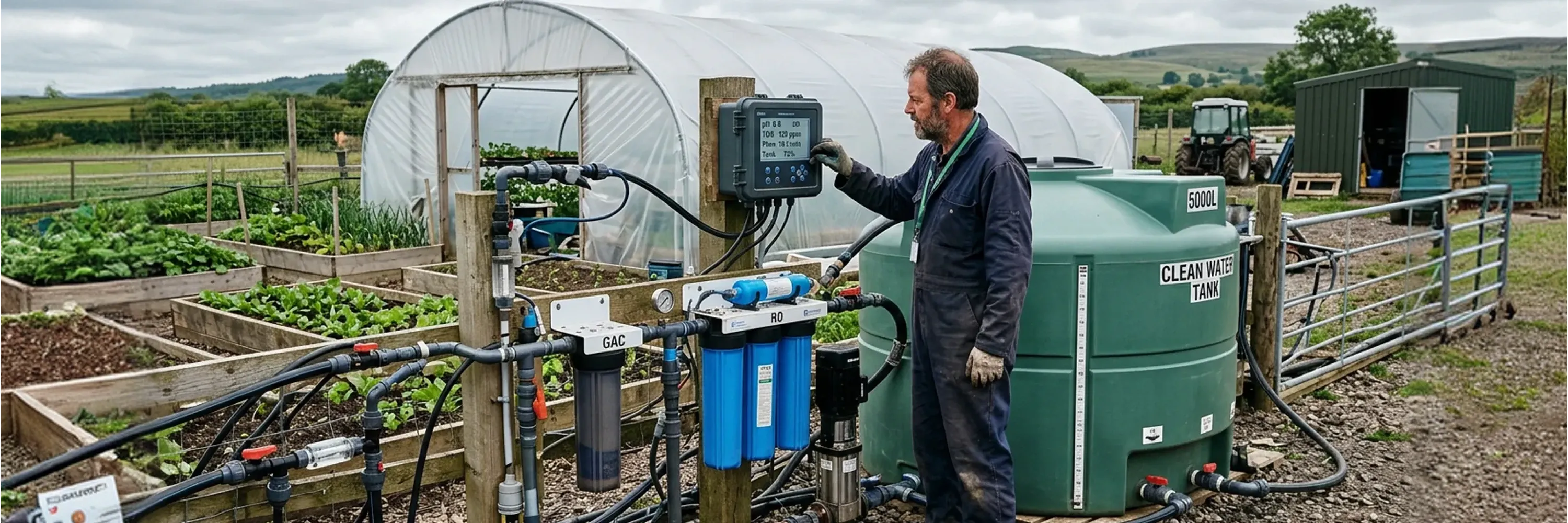
Two treatment categories cover most small-facility needs. Granular activated carbon (GAC) filters address taste, odor, chlorine residuals, and many organic compounds at relatively low cost. Industry estimates place basic GAC systems between $1,200 and $3,500 installed, with carbon replacement cycles every six to twelve months.
Reverse osmosis (RO) systems handle dissolved salts, heavy metals, and a broader contaminant range, but at higher cost and complexity. Small-scale RO installations typically range from $3,000 to $10,000, with annual maintenance costs between $800 and $1,500.
A practical hybrid approach combines whole-facility treatment with targeted point-of-use units. A whole-facility GAC filter removes bulk contaminants from the supply before water reaches any endpoint. Targeted point-of-use units at specific taps or process lines provide the higher purity that sensitive applications demand.
Upstream sediment pre-filters extend media life for both GAC and RO units and reduce membrane fouling. This layered approach keeps capital costs manageable because the expensive, high-performance technology only operates where it is necessary.
Unified Reuse Systems for Greywater and Rainwater
Greywater recycling and rainwater harvesting address different supply gaps, but they share storage, treatment, and distribution infrastructure. Separate projects duplicate tanks, pumps, filtration stages, and maintenance routines. A unified system treats them as complementary sources, eliminates that redundancy, and delivers a more balanced supply throughout the year.
A 2022 life cycle assessment published in the Journal of Cleaner Production examined a hybrid rainwater-greywater system in Bucaramanga, Colombia. The system saved approximately 131 cubic meters of potable water per year (42.5 percent of total consumption) and reduced wastewater flows to treatment plants by 20 percent. Similarly, research at the Tecnológico de Monterrey campus documented that combined greywater and rainwater systems achieved savings of 36 percent in single-family homes and up to 42 percent in multi-story buildings.
Greywater from sinks, showers, and laundry provides a stable daily volume independent of weather. Rainwater fills gaps in wet seasons and recharges storage reserves. When both sources feed into a shared tank through diversion lines and roof catchment systems, operators manage one treatment train instead of two.
A unified system design follows a straightforward sequence.
-
First, the facility calculates daily greywater generation and average monthly rainfall capture based on roof area and local precipitation data.
-
Next, operators size the primary tank to accommodate the combined volume plus a reserve buffer for dry periods. Tank materials should be rated for mixed-source storage: high-density polyethylene (HDPE) or food-grade polypropylene that resists biofilm growth.
-
Finally, a sediment and GAC filtration stage is installed between the tank and the distribution line, matched to end-use quality requirements identified through monitoring.
Sediment filters need monthly inspection. GAC media replacement follows the same six-to-twelve-month cycle described above. Tank cleaning typically occurs twice per year.
Disinfection Methods Aligned with Sustainable Water Management
Disinfection closes the reuse cycle and ensures that treated water meets safety thresholds before it reaches its end application. The chosen method should reflect a facility's operational reality, not theoretical best-case performance. Three options dominate at a small scale:
-
Chlorination remains the most accessible entry point. A cost analysis published in Greenhouse Product News found that chlorine-based treatment costs ranged from $0.07 to $0.13 per 1,000 gallons for large-volume operations, though costs for smaller facilities with lower volumes and manual dosing can be higher. The tradeoff involves chemical storage, handling requirements, and disinfection byproducts (trihalomethanes and haloacetic acids) that persist in treated water and the local environment. For facilities where sustainable water management goals demand minimal chemical residuals, this persistence creates tension between cost and environmental impact.
-
Ultraviolet (UV) exposure systems eliminate microbial threats without the introduction of chemicals into the water stream. UV is effective against a broad spectrum of microorganisms, among them chlorine-resistant pathogens like Cryptosporidium and Giardia, and requires only 20 to 30 seconds of contact time. Because UV adds no chemical residues, it avoids both the byproduct burden of chlorination and the high energy overhead of ozone generation.
-
Ozone-based systems offer the strongest oxidation potential of the three methods. Comparative analyses indicate that ozone destroys bacteria, viruses, and organic contaminants up to 3,000 times faster than chlorine. After disinfection, ozone reverts to oxygen and leaves no harmful residuals. However, ozone generation requires more energy and capital investment than either chlorination or UV, which makes it best suited for facilities with higher contamination loads or stricter quality requirements.
How to Choose Disinfection for Water Reuse Systems
The disinfection method a facility selects should align directly with the reuse application it serves. Subsurface drip irrigation may require only basic UV treatment or low-dose chlorination. Washdown stations where workers come into frequent contact with treated water demand higher microbial reduction, which makes UV or ozone more appropriate. Water reuse systems that serve food-contact applications require the most rigorous disinfection protocols, and ozone's ability to oxidize both microbial and chemical contaminants can provide an added margin of safety.
How Integrated Water Management Systems Connect Components
Monitoring, treatment, reuse, and disinfection generate value on their own. That value multiplies when these components operate as a coordinated sequence rather than parallel projects.
Monitoring reveals the specific contaminant profile present in source water and recycled streams. That profile dictates whether GAC filtration alone suffices or whether RO membranes must handle dissolved salts and metals. Treatment output quality then determines which reuse applications are safe: industrial boiler feeds tolerate higher TDS than precision parts cleaning, and process cooling tolerates higher turbidity than either. The intended reuse application, in turn, defines which disinfection method and intensity the final stage requires.
Monitoring then circles back to validate that the entire chain performs within design parameters. If post-disinfection coliform counts rise, operators trace the cause upstream and check whether treatment media needs replacement or whether source quality has shifted. Without this feedback loop, degradation goes undetected until a reuse failure forces reactive costs that far exceed what preventive adjustment would have required. Sustainable water management depends on this continuous validation cycle.
Phased Implementation Within Realistic Budgets
Financial constraints do not prevent integrated implementation; they determine the sequence. A phased rollout spreads capital expenditure across budget cycles and ensures that each phase produces usable data or measurable savings that justify the next investment.
Monitoring comes first because it costs the least and delivers the highest information value. A basic kit investment under $200 or a sensor package under $8,000 generates the contaminant profile that every subsequent decision depends on. Treatment hardware follows and targets the specific contaminants that monitoring identified. A facility whose data shows elevated TDS and low organic load can skip GAC filtration and invest directly in RO membranes. Reuse infrastructure layers in next. Disinfection arrives last and calibrates to the reuse applications already in operation.
Economic analyses of integrated water reuse systems in water-stressed regions consistently report three-to-five-year payback periods for small organizations. A separate study published in Water found that combined rainwater and greywater systems in multi-story buildings achieved payback periods of seven to eleven years even in moderate climates, and significantly faster in arid regions where water costs are higher.
How to Measure Progress and Track Results
Outcome tracking transforms water management from an expense line into a verified investment. The process starts when facility operators establish a consumption baseline: the total volume a facility uses per month or per production cycle before any system changes take effect. Utility meter readings, well pump logs, or tank level records all provide factual starting points.
Published research across multiple climates and facility types documents that small facilities with integrated systems report 25 to 42 percent reductions in overall potable water consumption, dependent on available sources, reuse volume, and local climate. Monthly comparisons between baseline and current consumption isolate the impact of treatment upgrades, reuse volumes, and seasonal variation.
Sustainable water management depends on this continuous measurement cycle because it confirms that interconnected components perform as designed and flags the point in the chain that needs attention when results fall short.
Conclusion
Isolated projects for monitoring, treatment, recycling, and disinfection prevent small facilities from their conservation goals. A coherent water management system, where data feeds treatment decisions, output quality enables safe reuse, and sustainable disinfection closes the cycle, produces measurable outcomes that standalone projects cannot match.
With 4 billion people who face water scarcity annually and 2.1 billion who still lack safe drinking water, small organizations have both the responsibility and the opportunity to act. Agritopia provides smart irrigation, fertigation controllers, and advanced water purification systems designed for efficient, sustainable operations. To explore how these solutions fit your facility, contact us for a consultation.