Introduction to Drinking Water Treatment
Drinking water treatment in North Africa has become a critical process because climate change fundamentally reshapes rainfall patterns and accelerates evaporation across the region. Historically, municipal systems relied on conventional chlorine to maintain public health standards.
Today, these legacy systems struggle to manage acute scarcity and increased contamination. For example, Egyptian water systems face critical stress with per capita water availability near 560 cubic meters annually. These systems rapidly expand their desalination capacity, and outdated disinfection methods jeopardize both public health outcomes and economic stability.
New facilities integrate drinking water treatment technology with solar energy resources to reduce chemical dependency and increase climate resilience. The following sections evaluate the scientific mechanisms, infrastructure integration, and implementation barriers of ozone disinfection to understand how it secures the water future of the region.
North Africa Water Crisis Prompts Disinfection Review
North Africa holds roughly 2% of the world's renewable freshwater, and its population depends on this fraction for agriculture, industry, and daily life. Climate change accelerates evaporation across the Sahara's northern fringe, intensifies drought cycles, and produces torrential autumn rainfall that overwhelms older potable water treatment infrastructure and fails to replenish aquifers. An objective assessment of regional hydrology shows a trajectory where the entire population confronts acute scarcity by 2050.
Country-level data clarifies the picture. The African Development Bank reports that water scarcity affects 40% of citizens in Morocco with inadequate access to safe water. Egypt's per capita availability hovers near 560 cubic meters annually, and this number falls well below the 1,000-cubic-meter threshold that defines absolute scarcity. Algeria and Tunisia face parallel pressures because aquifer drawdowns outpace recharge rates.
These conditions require an analysis that focuses on systemic change rather than incremental adjustment. Older chlorination infrastructure fails to close the gap between shrinking supply and rising demand. The region requires new disinfection technology to address this current water reality.
Why Conventional Disinfection Remains Inadequate for North Africa
Water chlorination has served public health for over a century, yet its limitations grow more pronounced in the operational environment of North Africa. When chlorine reacts with natural organic matter in surface water, it generates trihalomethanes and haloacetic acids. These disinfection byproducts accumulate in distribution systems and carry documented associations with health risks at high exposure levels.
The factual record on pathogen control raises similar concerns. Cryptosporidium and Giardia act as chlorine-resistant organisms that remain endemic across developing regions, and standard chlorination dosages fail to neutralize them. Health surveillance data shows that diarrheal disease affects millions annually in North Africa, and this data indicates that current disinfection protocols remain incomplete.
Maintenance failures compound these shortcomings. Even well-resourced utilities struggle with chronic equipment issues that budget allocations alone cannot resolve. These issues include the following:
-
Chemical injection pumps leak and deliver inconsistent chlorine dosages.
-
Blockages in injection points reduce disinfectant contact throughout distribution networks.
-
Storage and dosing equipment sustains corrosion damage because operators handle concentrated chlorine solutions.
Resource-constrained utilities in North Africa face these problems at a greater scale and employ fewer trained personnel to respond. Chlorine residues in the water supply also harm beneficial soil microorganisms that help with nutrient cycling. Because the region allocates most of its freshwater to farming and industry, conventional chlorine disinfection compromises soil health and undermines economic stability.
Ozone Potable Drinking Water Treatment Offers Superior Pathogen Control
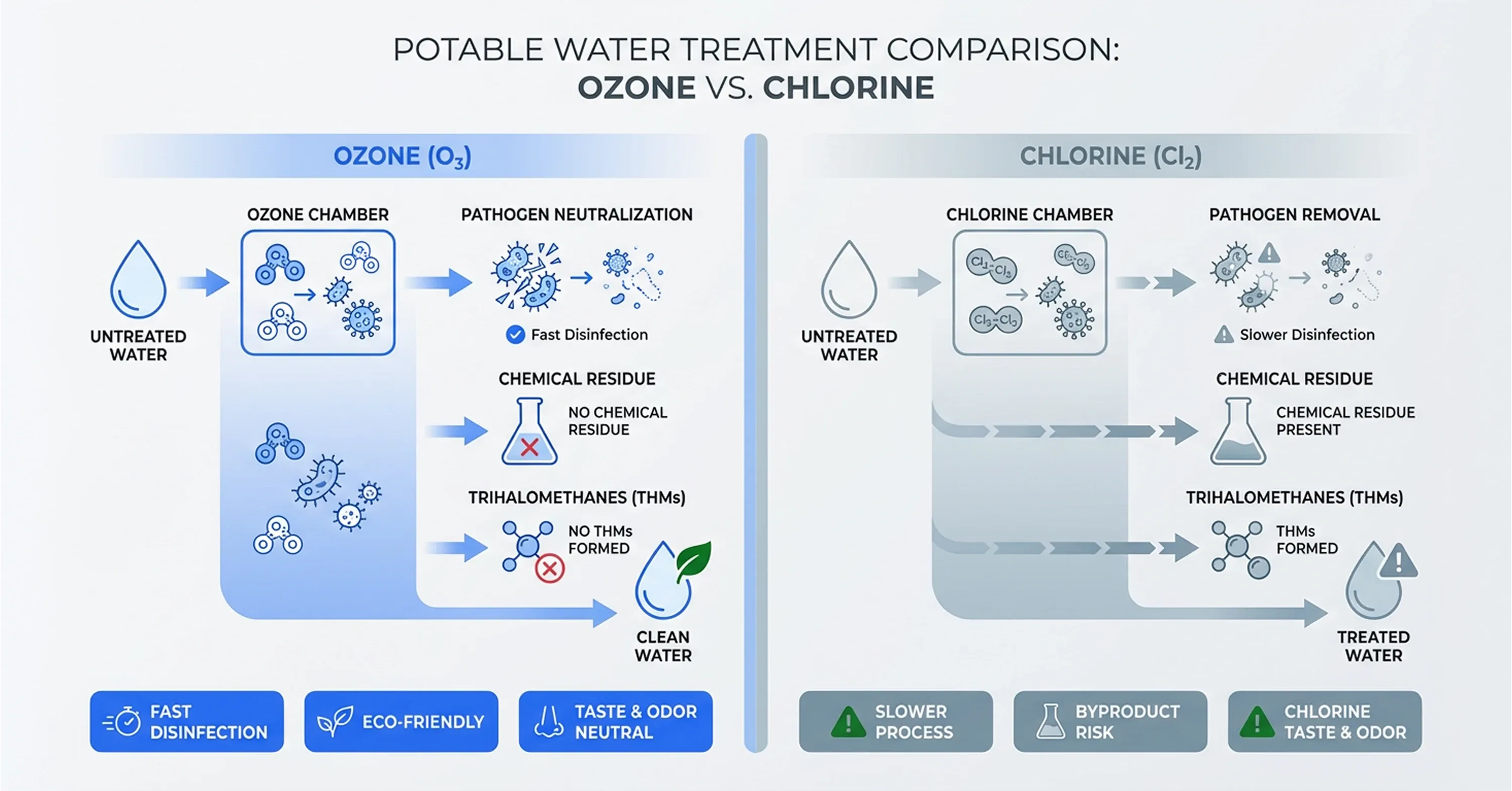
Ozone serves as a strong commercially available oxidizer for drinking water treatment, and its mechanism differs from chlorination in ways that matter for public health outcomes. When ozone contacts waterborne pathogens, it ruptures cell membranes and destroys nucleic acids. This chemical reaction translates into shorter contact times, smaller reactor footprints, and a definitive reduction in viable pathogen loads that leave treatment facilities.
The chemical profile after treatment demonstrates similar precision. Ozone spontaneously decomposes into molecular oxygen and leaves zero chemical residues in the water. Research published in the Water Research Journal confirms that ozone reduces trihalomethane formation compared to chlorination, and this chemical process removes a persistent health liability from the treatment cycle. Standard applications require minimal ozone concentrations with short contact times, and these parameters fall well within the operational capacity of modern facilities.
This residue-free profile carries implications beyond immediate pathogen control. Ozone treatment eliminates chemical storage requirements, reduces operator exposure risk, and produces effluent suitable for downstream agricultural use without the soil microbiome damage that chlorine residuals cause.
Direct Versus Indirect Oxidation Pathways
Ozone neutralizes contaminants through two distinct complementary pathways, and knowledge of both pathways helps with the evaluation of its advantage in potable water treatment.
The first pathway involves direct molecular ozone attack. Ozone molecules target electron-rich sites on cell membranes and organic compounds and oxidize them on contact. The second pathway generates hydroxyl radicals during ozone decomposition in water. These radicals represent highly reactive oxidation species, and they attack a broader range of molecular structures than ozone alone can reach.
This dual mechanism explains the effectiveness of ozone against organisms that resist single-pathway disinfectants. Peer-reviewed research in Frontiers in Microbiology** **documents that ozone inactivates targeted pathogens at low contact times and dosages. Salmonella enterica degrades rapidly after brief ozone exposure.
Ozone Efficacy Versus Water Chlorination
A structured comparison between ozone and water chlorination reveals operational differences that extend beyond raw disinfection speed. Chlorine requires sustained contact times that operators measure in tens of minutes, and it leaves residual concentrations that utilities must carefully manage throughout distribution networks. Ozone achieves superior pathogen inactivation in a fraction of that time and leaves no residual that requires downstream monitoring.
This distinction carries practical weight for facilities that produce treated water at scale. Facilities often implement desalination post-treatment solutions that rely on chlorine, but this approach introduces byproduct formation risk at the final stage of an advanced treatment chain.
Ozone resolves this issue because it matches the advanced nature of reverse osmosis membranes with equally advanced disinfection chemistry. This chemical match creates a sequence where no single stage undermines the quality gains of another stage. Facilities use this sequence to integrate ozone directly into large desalination plants.
Ozone Integration Within Desalination Infrastructure
The Middle East and North Africa region accounts for a significant portion of global operational desalination capacity, and approximately 5,000 plants produce massive volumes of water daily. Governments across the region plan to nearly double this capacity between 2024 and 2028. This expansion represents a practical opportunity to embed advanced drinking water treatment at the infrastructure design stage rather than retrofit it years later.
Treated water emerges from desalination systems largely free of salt content, but it still carries remaining microbial loads and trace organic compounds that require post-treatment. Ozone serves multiple functions at this stage because it provides secondary disinfection for pathogen inactivation, oxidizes residual organics, and reduces compounds that cause taste problems.
Plants adopt ozone post-treatment minimizes chemical disinfection byproducts in the final product water. Properly treated water from these systems successfully meets Lebanese compliance standards for public distribution.
Electrochemical ozone generation provides an additional advantage for this integration. This new technology produces ozone directly from water through electrolysis, and this process enables desalination plants to generate their own disinfectant on-site without chemical supply chain dependencies.
A review of regional economics strengthens the case further. Desalination costs have fallen significantly over the past decade. These cost reductions make it highly viable to pair desalination with advanced ozone disinfection. New plants incorporate ozone systems into their original engineering specifications instead of applying aftermarket modifications, and engineers must match these specifications with reliable energy sources.
Solar Power for Ozone Generation in High-Irradiance Regions
North Africa's solar irradiance ranks among the highest on Earth, and this geographic fact makes an energy-intensive disinfection technology a realistic operational model. Ozone generators that use corona discharge or electrochemical processes demand consistent electrical input. Photovoltaic systems in the region can meet this demand with predictable output across 3,000 annual sunshine hours.
Solar power systems across the Middle East and North Africa increasingly integrate advanced oxidation processes for pathogen control. Economics and energy independence drive this integration.
Photovoltaic arrays power on-site ozone production and eliminate dependencies on grid electricity, chemical supply logistics, and imported disinfectant inventories. Remote and rural potable water treatment facilities operate far from centralized distribution networks and require this autonomy for continuous service.
Battery storage and intermittency management add upfront capital costs. However, declining photovoltaic module prices and the region's predictable solar resource reduce levelized energy costs year over year. This cost reduction makes solar and ozone integration a pathway to decarbonized operations and long-term cost savings.
Water, Energy, Food Nexus
Agriculture consumes 80 to 85 percent of North Africa's freshwater. The quality of this water shapes crop yields, soil health, and food security outcomes across the region. This interdependence shows that disinfection technology choices affect both municipal water supplies and agricultural systems.
Water chlorination introduces residual chemicals that accumulate in recirculated irrigation systems. These chemicals degrade beneficial soil microorganisms that cycle nutrients. Ozone treatment avoids this problem entirely because ozone decomposes to oxygen and leaves no persistent compounds in the effluent.
Morocco's structured investment approach illustrates how governments connect water infrastructure to food production. The Moroccan Ministry of Equipment and Water committed millions toward water security and desalination infrastructure through 2026. This financial commitment shows the direct link between treated water availability and agricultural output.
Morocco's dam fill rates recovered from 27.6 percent to 70.7 percent in recent years. However, climate projections indicate regional water resources could decline 20 to 30 percent by 2050. This tension between short-term recovery and long-term decline explains why treatment technology must serve municipal and agricultural demand simultaneously.
Implementation, Capacity, Regulatory Pathways for Drinking Water Treatment
Ozone-based drinking water treatment systems face financial, technical, and regulatory barriers across North Africa. Ozone systems cost more than basic chlorination equipment. Many small and medium water utilities lack the upfront funds to buy these systems. Regional lending markets compound this gap because they require high interest rates and strict collateral conditions that water enterprises struggle to meet.
Technical capacity presents an equally important challenge. Trained personnel must operate ozone generators, manage dosing controls, and troubleshoot electrochemical systems. Many North African utilities do not currently employ workers with these specific skills. Well-funded installations risk underperformance or premature failure unless utilities implement structured training programs for varying technical backgrounds. Intellectual property barriers, strict business registration processes, and complex tax incentives further slow the market entry of potable water treatment technologies.
Water utilities can overcome these financial and technical barriers if they connect ozone adoption to existing infrastructure financing mechanisms. These utilities can align ozone technology purchases with World Bank climate adaptation funding streams that target water resilience in vulnerable regions. Project planners can also integrate advanced disinfection specifications into African Development Bank water security project requirements.
This integration ensures new facilities include ozone from the design stage. Finally, multilateral development banks can develop co-financing models that reduce the capital burden on individual utilities by pooling regional demand.
Conclusion
In summary, ozone-based drinking water treatment offers North Africa a scientifically grounded path beyond the limitations of conventional chlorination. It neutralizes chlorine-resistant pathogens, eliminates disinfection byproduct formation, and leaves no chemical residues that compromise agricultural soil health or downstream water reuse.
When paired with the region's abundant solar resources and integrated into the desalination infrastructure that governments are already expanding, ozone becomes a practical and economically viable technology rather than a theoretical upgrade. The financial and technical barriers to adoption are real but surmountable through multilateral financing mechanisms and structured operator training.
Agritopia supplies ozone water treatment equipment designed for the agricultural and water management conditions of the MENA region. Contact us to discuss how ozone treatment technology can be matched to your facility's specific water quality challenges and infrastructure requirements.