Introduction
Household water reuse has become an essential practice that maintains sustainable properties and reduces utility costs. Most guides compare treatment methods for engineers and municipal operators rather than for residential applications. Residential systems produce lower flow volumes but handle a complex mix of soaps, personal care products, and organic matter. Greywater from showers and baths can contain thermotolerant coliform concentrations of 102 to 105 cfu/100 mL.
Standard setups often treat this water without professional monitoring, industrial-grade ventilation, or municipal safety nets. Each treatment method leaves a footprint inside a residence, in the soil, and in the water table below. Chlorine and ozone disinfect water effectively, but they behave differently when they interact with residential waste streams. Without proper context, these systems create risks that negatively impact human health and the local environment. This article examines how ozone and chlorine wastewater disinfection impacts health and surrounding environments at a residential scale.
Wastewater Disinfection Realities
Large facilities handle high flow volumes under strict professional oversight. Residential systems operate differently because households process lower flow volumes with a concentrated mix of contaminants. Households send soaps, personal care products, and pharmaceuticals down their drains every day. These varied inputs change the makeup of the greywater. Kitchen greywater contains chemical oxygen demand (COD) that ranges between 770 and 2050 mg/L due to food particles and detergents. This heavy organic load requires thorough treatment before reuse.
Certain treatment methods reportedly operate without chemical processes. This assumption distorts the evaluation of safety at the residential scale. Every disinfection method relies on chemical reactions to neutralize pathogens. Even systems marketed for chemical-free disinfection use oxidation processes to break down organic matter.
What Chlorine Does Inside Wastewater
These hidden chemical realities become evident when chlorine operates inside a residential system, where it disrupts the cell walls of bacteria and viruses and neutralizes these pathogens. This traditional method effectively manages pathogens commonly found in household wastewater.
However, chlorine creates unintended complications when it meets the organic matter present in residential drains. Chlorine-based disinfectants form organochlorine compounds and potentially harmful byproducts in wastewater. These chemical reactions happen continuously inside residential holding tanks.
Treated greywater often sits in storage tanks for hours or days before properties use it for landscape irrigation. Residual chlorine continues to react with organic materials during this storage period. This prolonged contact time creates disinfection byproducts (DBPs) such as trihalomethanes (THMs) and haloacetic acids (HAAs).
Studies show that trihalomethane concentrations increase post-chlorination when these compounds exist in wastewater before treatment. Attentive monitoring of these residuals prevents complications because typical households discharge a complex chemical mix into their plumbing.
Chlorination triggers specific reactions with common household inputs:
-
Shampoos and body washes from a daily beauty routine provide rich organic material that accelerates DBP formation.
-
Pharmaceutical residues interact with free chlorine and create unmonitored chemical compounds.
-
Household cleaning agents mix with chlorine and generate volatile gases in poorly ventilated plumbing systems.
What Ozone Does Inside Wastewater
While residual chlorine eventually reaches the environment, ozone performs wastewater disinfection and attacks the cellular structure of pathogens directly. This reactive gas oxidizes the cell membranes of microorganisms and destroys their internal components. Ozone possesses a higher redox potential of 2.07 V than chlorine for oxidizing organic matter. This oxidation capacity allows ozone to break down complex organic molecules efficiently.
Household wastewater contains a mixed-contaminant stream of soaps, medications, and organic waste. Ozone handles this varied mixture and dismantles the chemical bonds of these pollutants. This capability neutralizes emerging pathogens and adds no persistent chemical residuals to the water supply. The gas decomposes back into oxygen shortly after the treatment cycle ends.
Evaluating this technology requires analyzing its purification abilities and its operational requirements. Ozone treatment offers distinct advantages for handling complex residential waste streams, but the technology introduces specific environmental interactions.
Ozone Achieves Disinfection Goals
Ozone achieves these purification goals because it demonstrates effectiveness against emerging household pathogens and hard-to-kill microorganisms. The oxidation process destroys viruses, bacteria, and complex chemical structures simultaneously. Ozone acts as a strong oxidizing agent and breaks down complex organic molecules, including pharmaceutical compounds. This capability matters because households increasingly discharge medications and personal care products into their drains.
Ozone degrades rapidly and leaves no persistent residues in greywater holding tanks. The treated water remains stable, and this stability improves overall water safety for downstream irrigation. Ozone manages the mixed contaminants and does not build up harmful byproducts in the storage system. The rapid decomposition of ozone ensures that the stored water remains suitable for safe landscape application. This process ultimately achieves chemical-free disinfection goals and eliminates pathogens. The process leaves no permanent synthetic traces.
Indoor Air Risk
Even though the treatment process leaves no permanent synthetic traces in the water, the ozone equipment itself introduces potential indoor air quality concerns. Ozone generators operate near living spaces in many residential setups. These systems release unreacted ozone gas into the surrounding environment through off-gassing. Monitoring the equipment rooms prevents immediate respiratory risks to people and pets from high ozone concentrations.
High ozone concentrations cause lung inflammation, coughing, sore throat, and difficulty breathing. Companies often market their systems as operating without chemicals, but this gas remains a respiratory irritant. Proper ventilation and professional installation mitigate these risks. These measures help the system maintain both air and water purity. Without adequate exhaust infrastructure, small utility rooms accumulate unsafe gas levels that migrate into occupied areas of the house.
Side-by-Side Health Risks
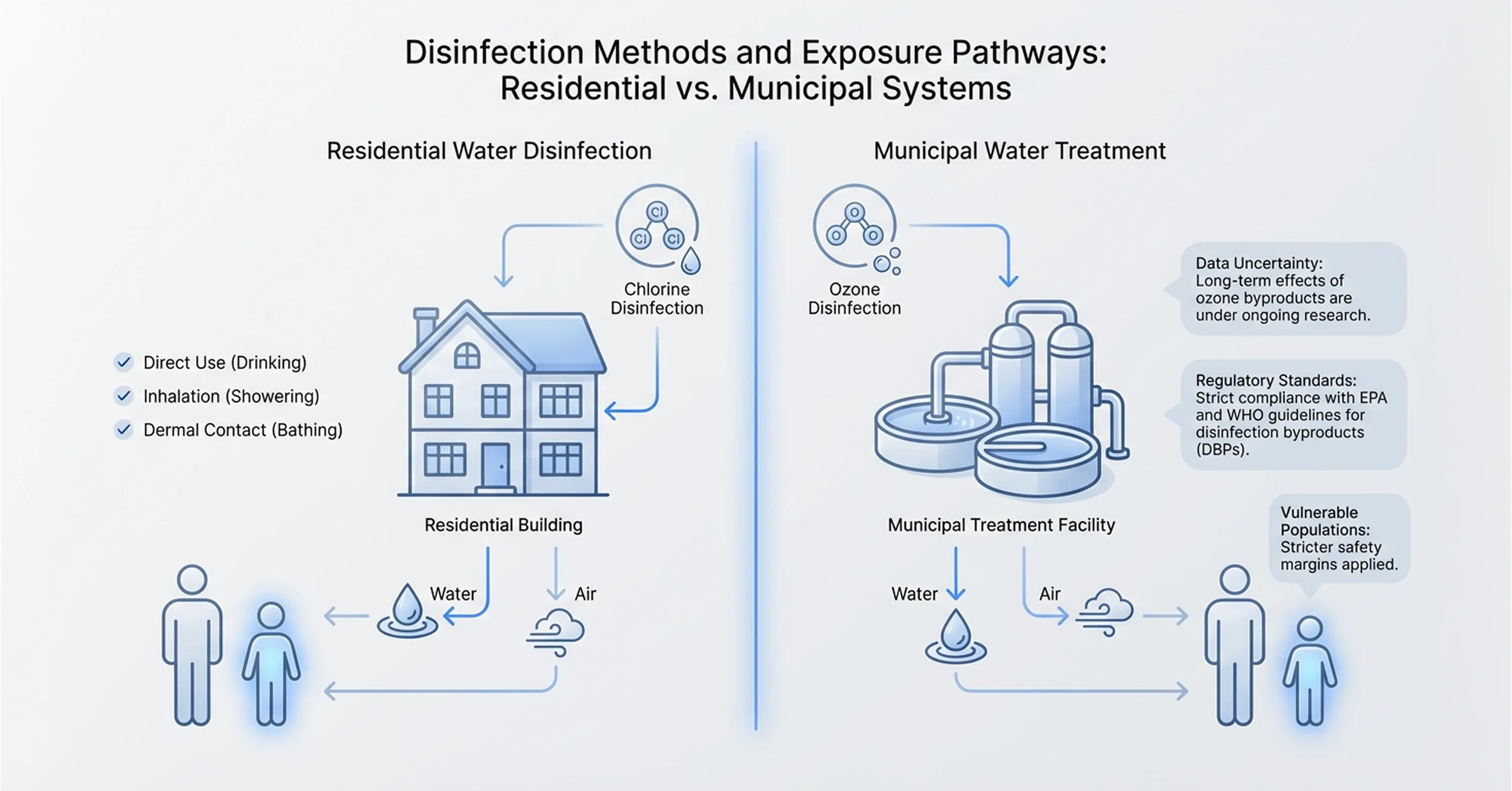
This gas migration shows how health risks from wastewater disinfection change dramatically when treatments occur inside residential buildings rather than at municipal plants. Residential systems create two distinct exposure paths depending on the chosen technology. Residual chlorine creates chemical byproducts that remain in the water, and ozone systems introduce the risk of gas leaks into indoor air.
Sensitive populations face higher vulnerabilities to these specific exposures. The Environmental Protection Agency states that children face the greatest risk from ozone exposure because their lungs are still developing. Equipment placement affects household air quality if a gas leak occurs.
Chlorine systems pose different risks when residents handle reused greywater indoors. Residents expose themselves to disinfection byproducts through skin contact and inhalation when they flush toilets or wash clothes with chlorine-treated water.
Currently, researchers lack long-term chronic exposure data regarding these specific residential scenarios. This missing data forces reliance on municipal standards that do not perfectly translate to household environments. Building occupants must evaluate specific personal vulnerabilities to ensure complete water safety.
Soil Groundwater Interactions
Beyond these local human exposure risks, wastewater disinfection determines what chemicals eventually reach the soil and shallow groundwater around a residential property. When properties irrigate gardens with treated greywater, the residual treatment components interact directly with the local ecosystem.
These environmental interactions require tracking over time because small changes compound over years of daily watering. Prolonged greywater application changes the soil chemistry and affects how plants absorb nutrients. For example, researchers observed an increased soil pH level above 9 at several monitored sites after long-term greywater disposal. Plants often struggle to thrive in normally healthy garden beds when these chemical shifts occur.
Each treatment method interacts with the surrounding landscape in specific ways:
-
Soil Microbiology: Chlorine residuals suppress beneficial soil bacteria and disrupt fungal networks necessary for nutrient breakdown. Ozone breaks down rapidly before reaching the soil, and this allows beneficial microbes to survive and maintain a healthy soil ecology.
-
Plant Health: Persistent chemicals in treated water accumulate in plant tissues over multiple watering cycles. Studies indicate that residual chlorine reduces silicon and iron uptake in plants, and this impairs plant resistance to adverse environmental conditions.
-
Groundwater Contamination: Shallow water tables sit vulnerable beneath many rural residential properties. Chlorine disinfection byproducts can leach through porous soil profiles and contaminate these underground water sources. Ozone leaves no persistent chemical trail, and this eliminates this specific groundwater leaching risk.
These interactions demonstrate why the selection of a treatment system requires a review of more than just indoor equipment costs.
Treatment Method Scenarios
Because this evaluation goes beyond equipment costs, the selection of the right wastewater disinfection method depends entirely on the specific conditions of a property. Neither chlorine nor ozone serves as a universal solution for every residential building. A proper evaluation assesses the unique house layout, daily water usage habits, and long-term landscape goals.
Chlorine makes practical sense for specific scenarios. This traditional method costs less upfront and requires simpler maintenance routines. Many residential setups use chlorine when they reuse treated water strictly for toilet flushing rather than for landscape irrigation. This approach isolates the chemical byproducts from the soil and edible plants.
Ozone offers distinct benefits for properties focused on irrigation and pathogen control. This method neutralizes emerging contaminants and pharmaceutical residues from products. Furthermore, ozone decomposes naturally into oxygen after treatment, and it leaves no harmful residues in the water. While companies market this as chemical-free disinfection, the process still requires strict safety measures. Ozone generators demand professional installation and excellent ventilation to prevent indoor air hazards.
Conclusion
The chosen wastewater disinfection method carries distinct health and environmental implications for residential use that go beyond simple equipment costs. Ozone and chlorine systems each present unique trade-offs when they operate at a household scale rather than a municipal treatment plant.
Matching the right system to the specific conditions of a property determines whether the chosen method genuinely protects both occupants and the surrounding environment. Agritopia supports this decision process by supplying ozone water treatment equipment suited to residential and agricultural water management needs. Contact us to find out which solution fits your property's specific requirements.