Introduction to Water Quality Enhancement
Water quality enhancement has become a critical priority for communities worldwide. Middle Eastern and North African regions face severe challenges because distribution networks degrade desalinated supplies before the water reaches households. Historically, households relied on municipal treatment facilities to deliver treated water directly to their taps.
Today, aging infrastructure and complex regional demands compromise this delivery, and this forces people to seek supplementary treatment options. Many people assume a single pitcher or basic filter resolves all contamination issues. However, consumer water filter pitchers do not remove all of the contaminants they claim to eliminate. Purchasing a single filtration device leaves entire categories of physical, chemical, and biological threats untouched.
Understanding how different treatment methods work allows communities to implement effective solutions. This guide compares physical filtration, chemical oxidation, and ozone-based disinfection. The text aligns specific technologies with the exact contamination problems they solve and addresses the unique distribution challenges in regional desalination networks.
Limitation of Single-System Solutions
Most water purification systems promise broad protection, but their actual performance tells a different story. A single carbon pitcher filter reduces chlorine taste, yet it leaves bacteria, viruses, and dissolved heavy metals untouched. A reverse osmosis unit removes lead and fluoride with impressive efficiency, but it fails to prevent microbial regrowth in storage tanks or distribution lines. Each device addresses a narrow band of contaminants, and the categories it ignores remain active threats.
This gap between expectation and capability creates a false sense of security. Facilities that install one system and assume the problem is solved consume water contaminated with pathogens or chemical compounds that the device was never designed to handle. Lebanese drinking water compliance standards confirm that multi-stage treatment systems remove more contaminants than single-technology approaches because each stage targets a different contamination category.
Precise identification of the contaminants present in a water supply precedes any equipment purchase. A targeted response built around verified test results always outperforms a generic device. The evaluation of major treatment technologies begins with physical filtration methods to explain how they work, what they remove, and where they fall short.
Physical Filtration Methods and Limitations
Physical filtration forces water through barriers that trap contaminants based on particle size, chemical affinity, or membrane selectivity. Three foundational technologies dominate this category, and each operates within exact performance boundaries. Sediment filters capture sand, rust, silt, and other visible particulates down to approximately 1 micron, but they fail to remove dissolved chemicals or microorganisms.
Granular activated carbon filters adsorb chlorine, volatile organic compounds, and taste-causing chemicals onto their porous surfaces. Reverse osmosis systems push water through a semi-permeable membrane that rejects lead, fluoride, uranium, arsenic, and total dissolved solids at rates above 90 percent.
Despite these strengths, each method has blind spots. Granular activated carbon does essentially nothing against bacteria or viruses. Reverse osmosis rejects three to four gallons of water as brine concentrate for every gallon it produces, strips beneficial minerals, and produces flat-tasting output. Sediment filters leave all dissolved contaminants and pathogens in the water.
Chemical Oxidation for Contaminant Transformation
Chemical oxidation operates on a fundamentally different principle than filtration. Oxidizers change the molecular structure of dissolved substances and convert them into forms that settle out of solution. This distinction matters because many common water problems pass straight through physical filters in their dissolved state, and these problems include dissolved iron, manganese, and hydrogen sulfide.
Chlorination remains the most widely used advanced water disinfection method globally. It effectively treats most bacteria and viruses, and it leaves a residual concentration in treated water that protects the water during storage and distribution. However, chlorine reacts with organic matter to produce disinfection byproducts that include trihalomethanes, and it affects taste at concentrations above 0.5 milligrams per liter.
When iron combines with organic matter or iron bacteria colonize a well, potassium permanganate offers a specific advantage. Water treatment data documents that potassium permanganate oxidizes manganese and iron in municipal applications, and it functions across a broad pH range. This makes it particularly valuable for rural well water and for regional systems where iron and bacterial contamination overlap.
Accurate dosing prevents problems that under-dosing and over-dosing cause, and standard chemical oxidation fails to remove the resulting precipitates without a downstream filtration step, which prompts towards ozone-based disinfection.
Ozone-Based Disinfection for Water Quality Enhancement
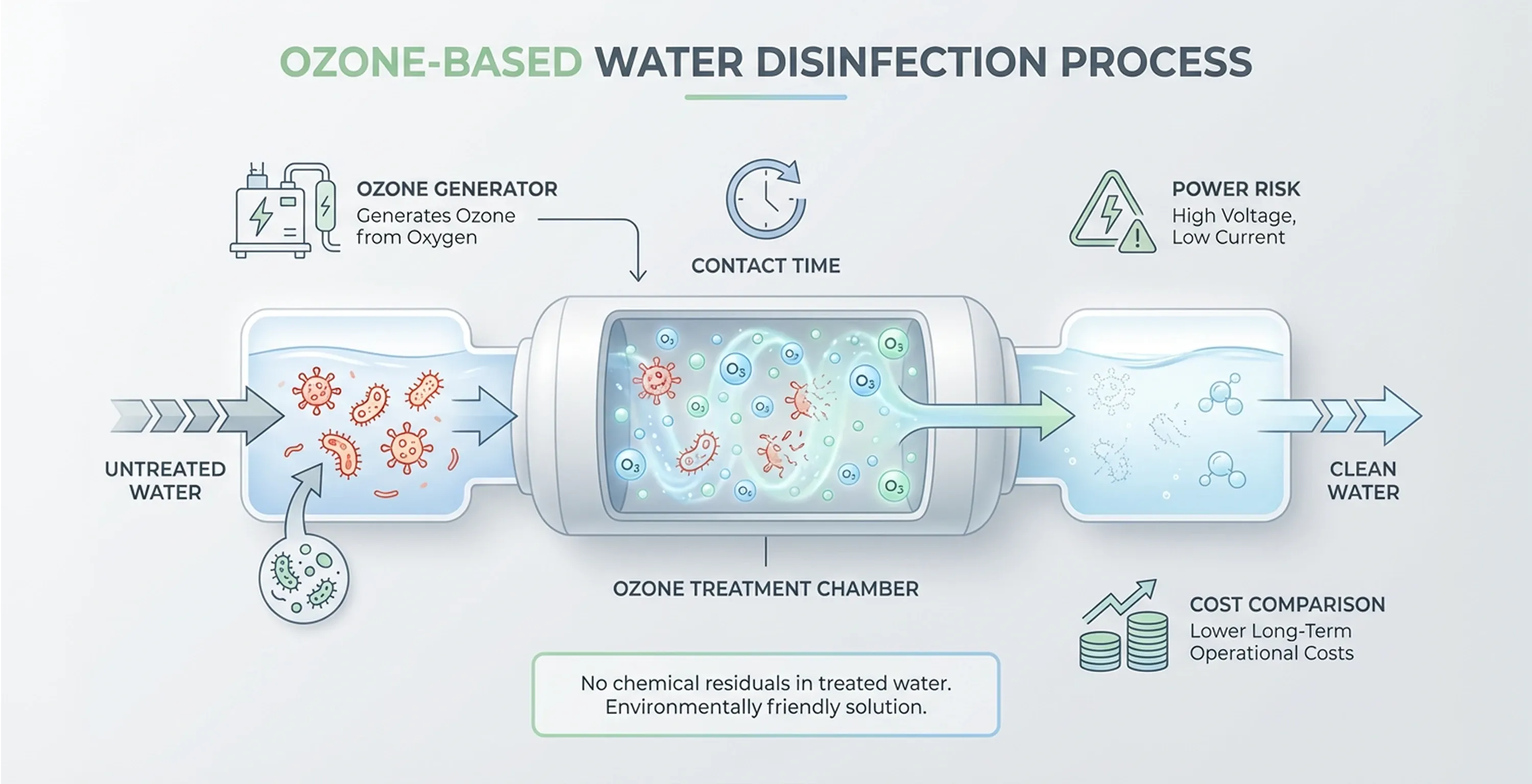
Ozone stands apart from other disinfectants because it achieves water quality enhancement through one of the most powerful oxidation reactions available, and then it decomposes into pure oxygen without leaving chemical residuals in treated water. On-site generators pass dried air or oxygen through a high-voltage electrical field to produce ozone, and the gas dissolves into water where it attacks cell membranes of bacteria, viruses, and protozoa.
Effective ozone treatment requires defined residual doses with specific contact times typically ranging from 10 to 30 minutes. At these concentrations, ozone inactivates chlorine-resistant organisms that include Cryptosporidium and Giardia more effectively than either chlorine or ultraviolet light alone.
The trade-offs, however, are substantial. Ozone generation demands reliable, continuous electricity and corrosion-resistant stainless-steel infrastructure. Capital costs run significantly higher than chemical oxidation processes like chlorination. Water with high suspended solids or dissolved organic carbon consumes ozone before it reaches target pathogens, and this consumption reduces disinfection effectiveness.
In areas where electricity supply fluctuates, ozone becomes viable primarily for facilities with structured, stable power infrastructure or dedicated renewable energy installations. Without dependable power, the ozone generator fails to maintain the consistent dosing that safe disinfection requires, and this constraint makes ultraviolet disinfection an attractive supplement.
Ultraviolet Disinfection Supplements
Ultraviolet disinfection exposes microorganisms to light at a wavelength of approximately 254 nanometers, and this exposure damages their DNA and prevents replication. The process adds no chemicals, produces no byproducts, and maintains water taste or odor. This makes ultraviolet light attractive for facilities that want pathogen control without introducing additional substances into treated water.
Ultraviolet systems handle chlorine-resistant parasites that include Cryptosporidium and Giardia with exactitude that chemical disinfectants alone cannot match. However, ultraviolet light provides no residual protection after the water passes the lamp. Once treated water enters a storage tank, distribution pipe, or building plumbing line, it becomes vulnerable to recontamination. Water treatment studies confirm that ultraviolet light fails to prevent post-treatment contamination in distribution lines, and this limitation means ultraviolet systems work best as a final-stage barrier rather than a standalone solution.
Source water clarity also limits ultraviolet performance. Turbid water scatters and absorbs ultraviolet rays before they reach target organisms, and this reduces the precise dose each microbe receives. Suspended particles shield bacteria from exposure entirely. These constraints make pre-filtration an essential companion to any ultraviolet installation that relies on photolysis mechanisms.
Photolysis Mechanisms in Water Treatment
Ultraviolet photolysis works at the cellular level. When ultraviolet rays penetrate a microorganism's cell wall, the energy disrupts thymine bonds in the organism's DNA strand. This precise disruption prevents the cell from reproducing, and an organism that cannot reproduce cannot cause infection.
The mechanism depends on direct contact between ultraviolet photons and microbial cells. Sediment, iron particles, or organic matter suspended in water absorb and scatter photons before they reach their targets. A sediment pre-filter with a 5-micron rating removes the physical obstructions that would otherwise compromise ultraviolet light treatment effectiveness.
Without this upstream stage, even a high-output ultraviolet lamp fails to guarantee sufficient dose delivery to every organism passing through the chamber, and this vulnerability requires the integration of advanced water disinfection strategies.
Integration of Advanced Water Disinfection Strategies
System designers combine ultraviolet modules with chemical residual agents, and this combination creates layered protection that covers both the point of treatment and the distribution path beyond it. Chlorination at a storage tank maintains a low-level residual that guards water during transit and storage. An ultraviolet unit at the point of use then inactivates any chlorine-resistant organisms and any microbes that entered through compromised plumbing.
This pairing addresses the exact weakness each method has on its own. Chlorine fails to handle Cryptosporidium, and ultraviolet light fails to protect water after it leaves the lamp. Together, they cover the full spectrum of biological threats from tank to tap. Point-of-use ultraviolet installations also suit facilities connected to aging municipal networks because treated water degrades before it reaches the faucet, and this reality emphasizes the need for multi-stage water quality enhancement approaches.
Multi-Stage Water Quality Enhancement Approaches
Each treatment technology addresses a distinct contamination category, and this specialization explains why layered configurations perform better. Sediment filters catch particulates. Activated carbon adsorbs dissolved chemicals. Reverse osmosis rejects heavy metals and salts. Chemical oxidizers transform iron and manganese. UV and ozone neutralize biological threats. No single device spans all five categories, so water purification systems that combine multiple stages close the gaps that any individual technology leaves open.
Structured configurations for municipal-supplied water pair a sediment pre-filter with granular activated carbon and a point-of-use UV lamp. This sequence removes particulates first, eliminates chlorine taste and volatile organics second, and inactivates residual pathogens third. For well water with both chemical and microbial contamination, reverse osmosis and a subsequent UV unit provide measured protection against dissolved metals and biological threats in a single line.
Off-grid properties face a different profile. Chlorination at the storage tank maintains residual protection during holding and distribution, and a UV unit at the tap handles chlorine-resistant organisms like Cryptosporidium before consumption. Pairing a residual disinfectant with a point-of-use barrier achieves what neither method achieves alone, particularly when systems navigate distribution and remineralization challenges.
Distribution and Remineralization Challenges
Many water systems depend heavily on desalination, and the treatment challenges extend far beyond the plant gate. Desalinated output arrives mineral-depleted and requires remineralization before distribution. Once remineralized water enters aging pipe networks, it encounters a specific set of threats that the desalination plant was never designed to address.
Pipe corrosion introduces metals. Biofilm colonies establish themselves along interior surfaces. Pressure drops from leaks allow soil-borne contaminants to infiltrate supply lines. The World Bank's Lebanon Water Sector Review found that Lebanon's water distribution system experiences 40 percent non-revenue water losses. This means nearly half the treated supply either leaks out or diverts before it reaches consumers.
These conditions demand targeted intervention at the point of use rather than sole reliance on centralized treatment. Activated carbon addresses taste and odor changes that remineralization additives cause. Ozone controls biofilm in desalination infrastructure distribution networks. UV provides a final biological barrier where compromised plumbing renders upstream advanced water disinfection unreliable.
Practical Decision Framework for Water Quality Enhancement
Water quality enhancement starts with an understanding of what the water contains, not with the selection of equipment from a catalog. Laboratory analysis identifies the exact contaminants present, their concentrations, and the treatment technologies best suited to address them. Without this step, projects risk investments in water purification systems that target problems the water lacks while overlooking the actual problems.
The matching logic follows a defined pattern. Bacteria, viruses, and protozoa respond to UV, ozone, or chlorination. Chlorine taste and odor yield to activated carbon. Lead, arsenic, fluoride, and other dissolved metals require reverse osmosis membranes. Iron and manganese in their dissolved forms need oxidation with potassium permanganate or ozone, and a subsequent filtration stage captures the resulting precipitates. Post-treatment recontamination in storage tanks or distribution lines calls for residual chlorination or point-of-use UV.
Fluoride illustrates why laboratory results matter before any purchase. Lebanese drinking water standards set a maximum allowable limit of 1.5 milligrams per liter for fluoride to prevent dental fluorosis. A well with fluoride at 3.0 milligrams per liter needs reverse osmosis. A municipal supply with fluoride already below the limit gains nothing from the addition of that same membrane. Prior testing prevents both over-investment and under-protection, but even carefully selected equipment requires strict maintenance schedules for sustained system performance.
Maintenance Schedules for Sustained System Performance
A well-chosen treatment system still fails if maintenance lapses. Expired carbon cartridges stop adsorbing contaminants and become breeding grounds for the bacteria they once blocked. Fouled reverse osmosis membranes lose rejection capacity. UV lamps degrade over time and emit insufficient energy to achieve the dose that inactivates pathogens. Every component in advanced water disinfection systems operates within a service life, and failure to follow that timeline turns protective equipment into a liability.
Climate amplifies these risks. Research on microbial contaminants confirms that biofilm re-formation accelerates at water temperatures above 25 degrees Celsius. Regions where ambient and water temperatures routinely exceed this threshold face faster biological fouling of filters, membranes, and storage tanks. Treatment systems in these environments require shortened replacement intervals and more frequent flushing.
Proper maintenance requires operators to track each component's service date and replace it on schedule, not when performance visibly drops. Precise monitors for pressure differentials across filters, UV lamp output intensity, and residual disinfectant concentration catch degradation before it compromises water safety.
Conclusion
To summarize, water quality enhancement depends on matching the right technology to the verified contamination profile of a specific supply rather than selecting a device from a catalog. Filtration removes particulates and dissolved chemicals but leaves biological threats untouched. Chemical oxidation transforms dissolved iron and manganese but requires downstream filtration to capture precipitates. Ozone and UV disinfection neutralize pathogens that chlorination alone cannot handle, but each requires complementary stages to cover the full contamination spectrum.
In MENA's aging distribution networks, no single method closes every gap, and layered configurations consistently outperform standalone solutions. Agritopia supplies ozone water treatment equipment and sustainable water management technologies designed for the agricultural and infrastructure conditions of the MENA region. Contact us to identify which water quality enhancement approach fits your specific contamination profile and distribution environment.