Introduction
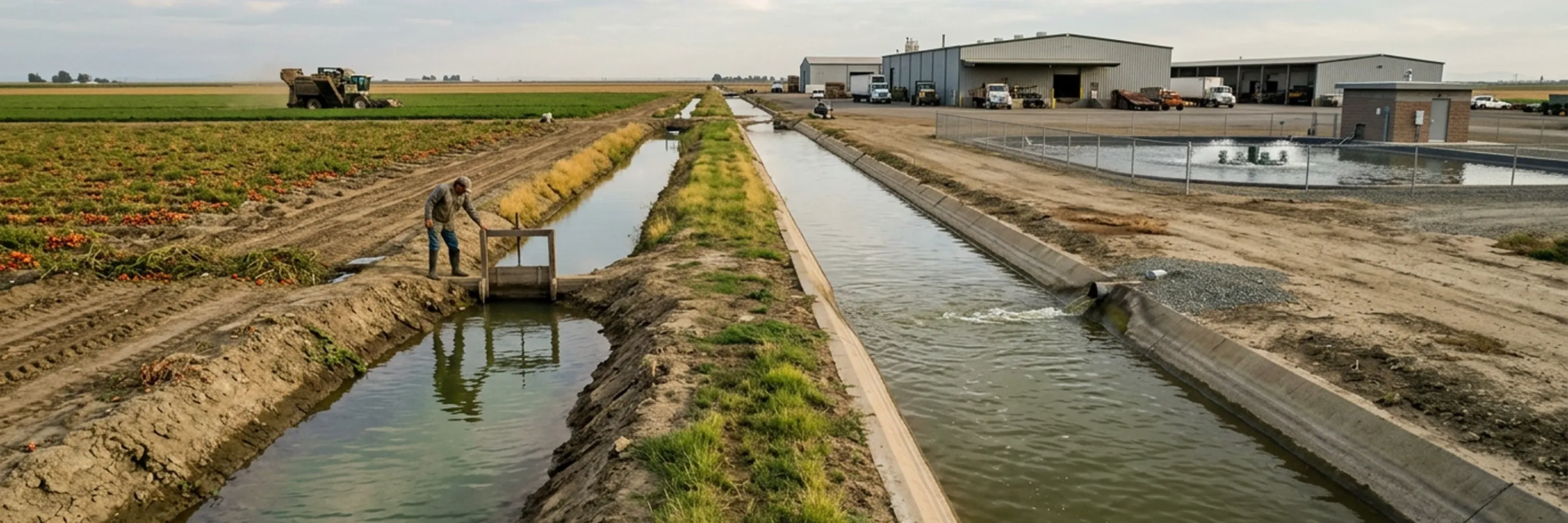
For over a century, the food processing sector used chlorine-based disinfection as the default methodology because it effectively reduced microbes and offered economic benefits. However, modern resource management faces new realities. Documented contamination of the Nile River system presents a new challenge. Industrial runoff contributes 39.4% of heavy metal pollution. This runoff combines with agricultural chemicals and untreated sewage and creates a complex contamination issue. This complex mixture pushes Egypt's primary water source beyond the boundaries of what chlorine can chemically address.
Simultaneously, Egypt's per capita water availability declined to approximately 500 cubic meters annually. As water scarcity intensifies, international regulatory frameworks tighten their standards. This situation requires a reassessment of water treatment in food industry applications across the region. Conventional systems no longer align with the chemical profile of the source water or the strict requirements of global export markets. The sector needs to transition to advanced purification technologies to maintain compliance.
Reality of Egypt Structural Water Deficit
Egypt's per capita water availability has dropped to roughly 500 cubic metres per year, and this drop places the country well below the United Nations threshold of 1,000 cubic metres that defines absolute water scarcity. This is not a projected trend but the current operating environment.
The deficit arithmetic shows a clear gap. Total annual demand reaches 88.55 billion cubic metres while renewable supply sits at just 65.35 billion cubic metres. Aggressive water reuse bridges the structural gap of 23.2 billion cubic metres. This deficit creates a daily operational constraint for facilities that depend on consistent, high-volume water for cleaning, cooling, steam generation, and direct product contact. Operations must maximize every litre, and every treatment failure carries amplified consequences because replacement water is not available on demand.
This deficit carries direct implications for process optimization across the sector. Effective water management strategies and treatment reuse protocols serve as the baseline requirement for maintaining production continuity rather than optional efficiency measures. The disappearing margin for waste or contamination forces organizations that manage water treatment in food industry operations in Egypt to strictly control the volume and quality of every sourced cubic metre, and this rigorous quality control requires a thorough understanding of the source water's specific pollutants.
Nile Complex Contamination Profile
The Nile's contamination profile presents a problem that requires scrutiny far beyond standard microbial testing. Multiple pollution vectors converge in a single water source, and each vector introduces contaminants that behave differently during treatment.
An environmental assessment report shows that natural and soil inputs account for 29.4% of detected contaminants, while transportation emissions contribute 31.3%. Industrial effluents add another 39.4% of heavy metal pollution. The system contains specific documented metals, such as:
-
Cadmium and lead from paper manufacturing and fertilizer production discharge
-
Chromium and nickel from textile industry effluents
-
Copper from food processing facility wastewater
-
Pesticide residues that include alachlor and atrazine from agricultural drain systems
Agricultural drains compound the problem further because they carry pharmaceutical compounds and excess nutrient loads into the same waterway. This combination creates a layered profile where heavy metals coexist with organic compounds, microbial pathogens, and chemical residues rather than a single-contaminant challenge.
This complex contamination requires precision in treatment design because each contaminant class responds to different removal mechanisms. A treatment system that focuses on microbial control alone does not remove dissolved metals and organic compounds. When operations focus on food safety water standards, the Nile's documented profile shows that source water characterization dictates the treatment architecture, and this requirement exposes the severe limitations of conventional chemical approaches.
Chlorine Limitations in Water Treatment in Food Industry Facilities
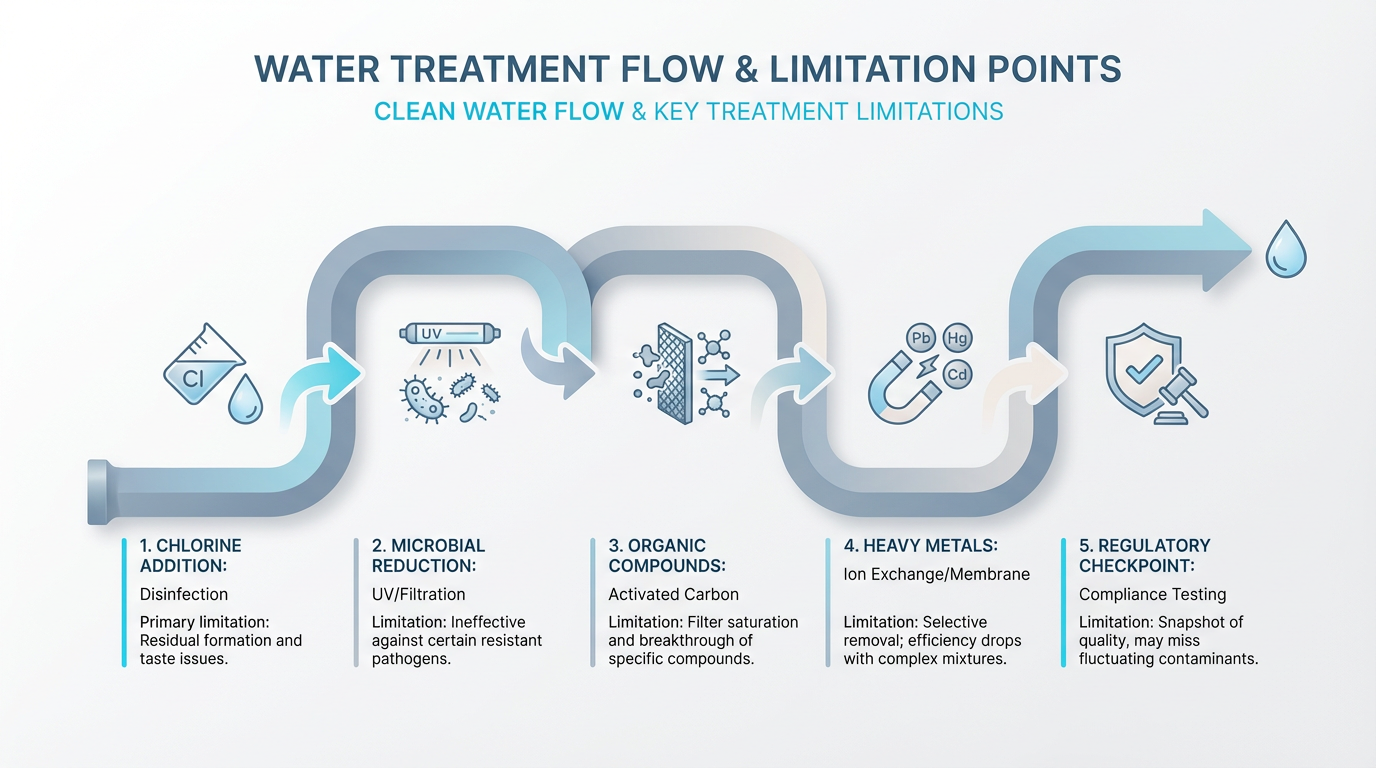
Chlorine disinfection works through a well-understood mechanism. Chlorine generates hypochlorous acid and hypochlorite ions that damage microbial cell membranes through oxidation after it dissolves in water. This approach delivers reliable results against bacteria, viruses, and many protozoan pathogens. However, problems begin when the incoming water carries contaminants that fall outside chlorine's chemical reach.
-
Dissolved inorganic heavy metal ions that include cadmium, lead, and chromium do not respond to oxidative disinfection. Engineers did not design chlorine to precipitate or bind these metals. These metals pass through chlorination unchanged, and a facility can reduce microbes while its process water still carries metals at concentrations that violate international food safety limits.
-
A second limitation emerges from chlorine's interaction with organic matter. The Nile's agricultural runoff loads the water with organic compounds, and chlorine generates trihalomethanes and haloacetic acids when it reacts with this material. In this scenario, water treatment introduces new contaminants, and any systematic evaluation of disinfection methods must account for this reaction.
-
A third concern involves the viable-but-non-culturable cell phenomenon. Research shows that chlorine can reduce culturable bacteria, yet intact viable cells persist at high concentrations. These cells can reactivate under favorable conditions that include temperature shifts or nutrient availability in downstream processing environments.
Standard culture-based testing may report compliant results while living organisms remain present. This gap between test results and biological reality shows why chlorine-only protocols lack the capabilities that modern contamination profiles require, and international regulatory bodies now update their standards to address these exact operational vulnerabilities.
Tightening International Regulatory Standards
International food safety frameworks continue to evolve, and this evolution compounds the challenge for Egyptian processors who deal with degrading source water quality. The regulatory environment now demands documented awareness of incoming water characteristics rather than just confirmation that endpoints meet microbial thresholds.
The FDA Produce Safety Rule mandates thorough agricultural water assessments that cover source characterization, distribution system integrity, and contamination protection measures. Facilities that export to the United States will need to demonstrate that their treatment methodology matches the specific risks present in their water source. Chlorine-only systems struggle to satisfy this requirement when the documented contaminant profile includes heavy metals and organic pollutants alongside microbial pathogens.
The European Chemicals Agency continues to tighten chemical exposure limits. The agency established new bisphenol restrictions that set a limit of 1 part per billion. The European Union also plans broader restrictions on per- and polyfluoroalkyl substances and considers wide bans on non-essential uses. The BRCGS Food Safety Global Standard already requires documented water treatment protocols, verification testing at defined frequencies, and contingency plans for treatment failures.
These converging standards create a bind that passive monitoring will not resolve for Egyptian processors who target export markets. Compliance with processing standards now requires documented evidence that treatment system design reflects measured food safety water risks, and that the chosen methodology addresses contaminant classes beyond microbial pathogens. Certification bodies increasingly audit the logic behind treatment selection rather than just the final test numbers, and this strict regulatory scrutiny forces facilities to transition from conventional chlorination to advanced alternative technologies.
Chlorine Dependence To Advanced Alternatives
Complex contamination profiles expose documented limitations in chlorine's performance and indicate a necessary shift in treatment architecture. Single-stage chlorination addressed microbial pathogens as the primary concern and handled relatively predictable contaminant loads during a simpler era of water chemistry. Current conditions in Egypt demand water treatment systems that address heavy metals, organic pollutants, disinfection byproducts, and microbial threats simultaneously.
Hybrid treatment platforms offer this capability and combine multiple technologies into integrated process trains. These platforms assess incoming water quality to determine which combination of oxidation, filtration, and disinfection stages activates at any given time, and this adaptability separates modern approaches from fixed chlorination protocols.
This technological shift happens across the market. According to Global Market Insights, the ozone generation technology market expands at a 7.1% Compound Annual Growth Rate toward $2.67 billion by 2034, and food and beverage applications represent approximately 17% of that market.
This growth reflects a broader industry recognition that process optimization in contaminated water environments requires technologies engineered for multi-contaminant removal rather than just microbial suppression. Facility operators match treatment technologies to documented source water risks and position themselves ahead of regulatory timelines and market expectations.
Food Safety Water Standards With Advanced Oxidation
Ultraviolet irradiation and chlorine combination treatment addresses one of the most persistent gaps in conventional disinfection. When ultraviolet irradiation interacts with chlorine in solution, the reaction generates reactive chlorine species, such as chlorine radicals, chlorine dioxide radicals, and hypochlorite radicals. These species attack bacterial cells through multiple oxidative pathways simultaneously, and this precision in cellular damage distinguishes the approach from standard chlorination.
This approach yields important practical outcomes. Research on UV/chlorine systems demonstrates that the treatment renders viable bacterial cells undetectable and does not merely suppress them below culturable thresholds. Optimized UV/chlorine protocols completely suppress dark reactivation, which occurs when chlorine-damaged cells recover metabolic activity in downstream environments. This eliminates the gap between culture-based test results and actual biological safety that characterizes chlorine-only food safety water treatment.
Ozone Generation Technology
Ozone operates as one of the strongest commercially available oxidizing agents, and its mechanism differs fundamentally from chlorine chemistry. Ozone molecules react with organic contaminants, microbial cell walls, and dissolved metals through direct oxidation and through the hydroxyl radicals that ozone decomposition generates. This dual pathway enables simultaneous disinfection and contaminant degradation within a single treatment stage.
Ozone provides a systematic advantage over conventional chemical applications because of its decomposition product. Ozone reverts to molecular oxygen after it reacts with target contaminants, and this means no chemical residues persist in treated water. Chlorine leaves residual compounds that operators must manage downstream. Operations pursue process optimization across multiple quality parameters, and ozone-based treatment reduces the total chemical burden on finished water while it expands the range of contaminants addressed in a single pass.
Adaptive Sensor-Driven Systems
Contamination profiles in the Nile River fluctuate weekly, and fixed treatment configurations lack the capacity to account for this variability. Adaptive sensor-driven systems solve this problem because they measure incoming water quality parameters in real time and adjust treatment intensity and methodology accordingly.
These platforms integrate continuous monitoring of turbidity, dissolved metals, organic carbon levels, and microbial indicators at the intake point. When sensor readings detect elevated heavy metal concentrations or spikes in organic loading, the system automatically shifts between chlorination, advanced oxidation, and membrane filtration stages. This responsiveness prevents under-treatment during contamination spikes and over-treatment during cleaner periods.
Operators often integrate the ozone method of water treatment into these adaptive frameworks because ozone dosing scales proportionally with measured demand, and its rapid decomposition avoids residual accumulation during low-contamination periods. Implementing these advanced platforms requires significant capital, and this financial need aligns directly with new regional government initiatives that fund infrastructure modernization.
Regional Innovation Pathways With Institutional Support
Egypt's government committed substantial infrastructure investment toward expanded treatment capacity, and these projects carry direct relevance for facilities that handle water treatment in food industry operations. The Bahr El-Baqar, El-Mahsama, and New Delta treatment facilities provide a combined capacity of 4.8 billion cubic metres annually, which represents a significant contribution toward a closed 23.2 billion cubic metre structural supply gap. These facilities do not eliminate the need for point-of-use treatment at processing plants, but they improve the baseline quality of water that enters municipal distribution networks.
The Water 2.0 strategy extends beyond physical infrastructure. The strategy incorporates satellite monitoring, predictive modelling, and smart resource management systems that generate data relevant to industrial water planning. Access to regional water quality trend data enables more accurate system sizing and technology selection for facility-level evaluations of treatment needs.
Grant programs also provide tangible financial support. The Water-Energy-Food Nexus 2.0 MENA Program offers average grants of USD 100,000 alongside technical assistance for enterprises that work across water management, agri-tech, and food processing.
This funding creates an immediate pathway for facilities that seek to pilot advanced treatment technologies without internal absorption of the full capital cost. Early engagement with these programs gives operations a concrete mechanism to fund the advanced treatment systems they need to handle complex contamination challenges, and these challenges include the severe pollutant spikes that occur during seasonal low-flow periods.
Seasonal Vulnerability During Low Flow Periods
The hydrology of the Nile introduces a seasonal dimension to contamination that fixed treatment designs often fail to anticipate. During April and May, the main Nile stream reaches its lowest annual level, and the White Nile alone provides over 80% of flow. This observation carries operational weight because reduced total flow volume means industrial discharges, municipal wastewater, and agricultural drain returns enter the river at the same absolute volume but mix into a much smaller water body.
This creates a concentration effect. Contaminant levels per liter rise during low-flow months even though total pollutant mass that enters the system remains constant. Heavy metals, pesticide residues, and organic compounds that a treatment system handles adequately during high-flow periods can exceed the system's design capacity when source water concentrations spike seasonally.
This seasonal vulnerability demands scrutiny in capacity planning. Treatment validation protocols that assume static incoming water quality produce misleading compliance confidence. Food safety water management requires testing and validation across the full range of seasonal conditions, such as the worst-case low-flow scenario.
Cleaning-in-place protocols, product contact water specifications, and microbial verification schedules require adjustment factors that account for the documented seasonal contamination curve. Operations that design treatment capacity for average conditions accept the risk of under-treatment precisely when contamination peaks, and these seasonal risks combine with regulatory pressures to demand a clear set of operational strategies.
Facility Operations Strategies
Contamination data, chlorine chemistry limitations, regulatory trajectories, and seasonal variability converge on a clear set of operational priorities. Facilities responsible for water treatment in food industry operations across Egypt face a window where proactive modernization represents a competitive choice rather than a crisis response.
The following steps translate the documented challenges into operational enhancements:
-
Facility managers audit existing chlorine-only treatment systems against the documented Nile contaminant profile to test whether the current configuration addresses dissolved heavy metals, pesticide residues, and disinfection byproduct formation alongside microbial targets.
-
Process engineers evaluate hybrid treatment architectures that combine advanced oxidation, ozone generation, and membrane filtration to cover the full contaminant spectrum present in source water.
-
Operations design treatment capacity for seasonal low-flow contamination peaks rather than annual averages and build validation protocols that test system performance under worst-case intake conditions.
-
Companies engage with available institutional support, such as the WE4F 2.0 MENA Program grants and the Aqua Energy Expo Middle East & Africa scheduled for September 14-16, 2026, in Cairo.
-
Compliance teams document treatment methodology selection with systematic evidence that links each technology choice to measured source water risks because international certification bodies now audit the logic behind treatment design rather than just endpoint test numbers.
Vigilance about the gap between current system capabilities and the converging demands of contamination reality and regulatory expectations separates facilities that maintain export market access from those that lose it. Processors build a clear path to lasting compliance when they address these interconnected challenges.
Conclusion
To summarize the major points, Egyptian food processors that serve global markets find chlorine-based protocols insufficient because Nile contamination complexity, absolute water scarcity, and rapidly tightening regulatory frameworks converge. These processors need hybrid treatment systems that combine advanced oxidation processes with real-time sensor-driven monitoring to maintain export competitiveness.
As these organizations look to the future, they can modernize operations through the Egyptian government's infrastructure investments and new grant funding programs. Agritopia specializes in advanced water quality enhancement and helps facilities implement reliable water treatment in food industry applications that meet regulatory standards. Reach out for a consultation to evaluate your facility's purification capabilities.